Viewing Category: Uncategorized

Tabell’s Market Letter – May 12, 1947

Tabell’s Market Letter – May 12, 1947

Tabell's Market Letter - May 12, 1947
View Text Version (OCR)

Technical Market Action The market went through another gloomy session on Monday with the market closing on the lov!s of the day. The industrial average declined 1.87 to 169.80 while the rails closed 45 cents lower at 44.52. Trading was very slow for the first four hours lith a turnover of only 420,000 shares. Volume picked up in the final hour, while the average Vias losing 99 cents, to total 700,000 shares for the day. At the day's low of 159.76, the industrials just touched the minor uptrend line extending through the April 15th low of 165.59 and the April 29th loVi of 167.42. Ability of this minor uptrend to hold would be encouraging. Penetration wo\lld mean a testing of the April low, although there is a good support level at 169-167. A penetration of this minor uptrend line Vlould not be as important marketwise as ability to cross the intermediate downtrend line from the February highs. /The market has again entered the upper part of the 150-170 range which has been a support area for the last nine months. Believe that this range is a broad accumulation il.re from which the market 'I!ill embark on another uptrend. II'hile; it is discouraging for the moment, the 1015 er the market remains in the accumulation area the greater becomes the base area and the eventual rally pOssibilities. Numerous issues are again getting close to buying levels. Believe E. VI. Bliss is one such issue. At Monday's close of 20 1/4, the stock Vias near the 1947 low of 19 l/e and 1946 low of 18 1/4. The 20-18 area is a very strong long term support level. Bliss reached a high of 26 5/8 in 1947 and has buHt up a very interesting base pattern. First quarter earnings v;ere 2.0l a share. May 12, 1947 EDMUND Vi. TABELL SHIELDS & COMPANY Closings Dow-Jones Industrials Dow-Jones Rails Dow-Jones 55-Stock 169.80 44.52 50.04 The opinions iIllp,-oued in this leHe, MO tho penon.!lt interpretation of cham by Mr. Edmund W. Tobell lind re not presented 41 the opinionl of Shield. & Compony.

Download PDF

Tabell’s Market Letter – May 15, 1947

Tabell’s Market Letter – May 15, 1947

Tabell's Market Letter - May 15, 1947
View Text Version (OCR)

Technical Market Action The market firmed on Thursday and the industrial average closed 1.20 higher at 167.88 while the rails were 17 cents higher at 45.24. Thursday's rise was the first up closing in nine trading days with the exception of the 15 cents rise of last Saturday. Volume was 770,000 shares. Excellent first quurter earnings reports, increased dividends, the ratio of stock to bond yields, the possibility of constructive fiashington legislation, large and yet unfilled needs, favorable business, income and employment indices and many other statistical figures would seemingly indicate that stock prices are greatly undervalued at present levels. This would seem particularly true when we take into consideration the fact that stocks are not selling at their highs but 25 to 70 below their peak levels of almost a year ago. It riould also seem particularly true when it is realized that the lows in the averages Vlere made almost nine months ago in anticipation of a drop in business that has not yet occurred except in a number of industries that were boomed to unprecedented heights by the war economy. It 1V0uld also seem particularly true when it is realized that, in relation to other things, stocks are about the cheapest thing money can buy. Stock prices are approximately 50 higher than their pre-war levels while prices of farm products are 200 higher, wholesale commodity prices are 100 higher, earnings of factory workers are 91 higher, manufactured products are 77 higher and the cost of living is 61 higher. owever, for the shorter term, stock prices are influenced mainly by public psychology rather than by intrinsic value. At the moment, a portion of the investing and trading public, after reading the gloomy prognostications of some economists, newspaper columnists and radio coentators of both local and foreign origin, is seemingly convinced that Vie are on the verge of a depression comparable to 1921, 1957, or even 1929. It is undoubtedly the best advertised depression that \7e have ever haa — if we have it. Another portion believes we are going to have a recession, others think we are going to have an adjustment and still others just a return to normalcy. The present market is evidently attempting to discount the extent of this foregone whatever you call it. This would seem to be a rather hazardous occupation at a price level \7here stocks are selling, in some instances, at two to four times their present rate of earnings to yield 8 to 12. Honever, public psychology is notable, at times, for temporarily swinging too far in either direction. The bearishness of today may eventually turn out to be as nonsensical as the wild scramble, just about a year ago, for new issues at two to ten points premium over their offering price regardless of intrinsic value. How much longer the bearish investor psychology will continue is open to question, but still consider the 170-160 area a long term buying range. EDMUND H. TABELL May 15, 1947 SHIELDS & COMPANY Closings Dow Jones Industrials Dow-Jones Rails Dow-Jones 65-Stock 167.88 45.24 59.14 n.. opiniOft e.p,eaed In this tetter r. the pet'W intarpretation of cherts by Mr. Edmund W. T.ban and .r. not present.d .s the opinions of Slti.td. , Company.

Download PDF

Tabell’s Market Letter – May 19, 1947

Tabell’s Market Letter – May 19, 1947

Tabell's Market Letter - May 19, 1947
View Text Version (OCR)

Technical Market Action Pepsi-Cola has shom ouch better action than the general market and its technical pattern is etremely interesting. Monday's low of 25 1/4 was still above the previous 1947 low of 24 3/4 reached in January and considerably above the October 1946 low of 21 1/2. The 1946 high as 40 1/2 and the stock reached 31 1/2 in the February rally of this year. Continued ability to hold above 24 would broaden the already large. base area around the 25 level. This base pattern indicates the possibility of an eventual rally to around the old 1946 high. Its technical action suggests excellent buying in the stock and indicates that it will probably hold above the rather important 24 level. Pepsi-Cola closed at 26 1/4 on Monday, a rally of a point from the day's low of 25 1/4. It would seem an interesting purchase on market irregularity Another issue that has shown excellent market action is National Supply. Its indicated long ter,. reaction, outlined by the early 1946 distribution range, was 15-10. This was the level mentioned in our general compilation of downside objectives listed on October 14th. The 1946 low was 11 7/8. On Monday, National Supply sold at 12 5/8 and closed at 15 1/2. The day's low was only 1/8 of a point below the previous 1947 10Vi of 12 5/4. A substantial potential base pattern has been formed around present levels that indicates an eventual rally to around the 1946 high of 25. Earnings for the first quarter of 1947 were 1.25 a share. The industrial average tested the October lows on Monday and, after reaching new lows for the current reaction, rallie(! in the final hour to close 55 cents higher on the day at 165.55. Both the clOSing price of 165.55 and the intra-day low of 161.38 were above the cOhlparable October figures of 165.12 and 160.49. The rail average reached a nel1 lOVi at 40.45 and closed 4 cents lower at 41.16. The 65-Stock Composite average reached a low of 56.56 and closed at 57.35 off 5 cents. If the industrials penetrate the October lows, stop loss selling could carry the market som9l1hat lower to a figure around the 55 1/2 55 1/2 level in the Dow-Jones 65-Stock Composite average. Both the New York Times and New York Herald-Tribune averages reached nel, intra-day lows on Monday but are close to the downSide objectives outlined in our letter of October 14th. In the same compilation, the downside objectives of over 400 issues were listed. The issues that did not quite reach their objectives in October are reaching them now while otilers are holding. Very few issues declined below their indicated objectives. In such cases, they were in volatile groups. Regardless of the possibility of a quick shake-out before a rally, believe many individual issues have reached or are very close to their lOWS! May 19, 1947 EDMUND 'ii. TABE!.L SHIELDS & COMPANY Closings Dow-Jones Industrials Dow-Jones Rails Dow-Jones 65-Stock 165.55 41.16 57.35 Th. opinions .,preued in this I.tter ere the penon&1 interpretation of cham by ,Mr. Edmund W. rabell and are nat pr…n'hd 4' the opinions of SM.r. eomp.lny.

Download PDF

Tabell’s Market Letter – May 21, 1947

Tabell’s Market Letter – May 21, 1947

Tabell's Market Letter - May 21, 1947
View Text Version (OCR)

Technical Market Action There are very few issues that have been able to show a definite uptrend in a general market that is selling close to its lows of the last nine months. One such issue is Pepsi-Cola which Vias mentioned in our letter of i\londay anLl has Doved up over three points froJ the low of that day. Another issue y.-ith a sillilar pattern is Cities Service. Cities Service reached a high of 41 7/8 in 1946 and subsequently built up a distributioal pattern that indicated a reaction to around 21. The October low nas 20 1/4. Since that time the stock has been in an uptrGnd vlith successively higher lows of 23 1/4 in January, 24 5/4 in April and 25 5/8 on Monday. Cities Service closeu at 28 1/4 on liednesday, up 1 5/4 0;1 the day. The base pattern built up over the past nine months indicates the possibility of an eventual price objective well above the 1946 high of 41 7/8. This year's high is 52 5/8. Recent SEC approval of Cities Service recapitalization plan brings the ultimate capital set-up nearer to cOnsummation. Eventually the stock, after disposal of public utility properties, will be the common stock of an oil and natural gas co,;lpany with estir.lateci earnings of around 6 a share. Believe the issue offers interesting profit possibilities. The market turned strong on Wednesday and, o volume of 1,020,000 shares, closed up 2.18 on the industrials at 165.77 and 68 cents higher all the rails at 42.14. The lllarket is drawing m,ay from our suggested 164-161 reaction obj ective, which was reached at Monday's low of 161.58. The rails also r.let supIJort OIl Monday at 40.45, a shade below our 42-n objective. The New York Times and New York Herald-Tribune averages also Jlet support at or near their long range down objectiveR of 107-95 and 112-109, respectively. Monday's lows were 105.51 and 115.90. Expect the current rally to carry further. May 21, 197 EDMUND Ii. TABELL SHIELDS & COMPANY Closings Dow-Jones Industrials Do,–';onE's Rails Lew ..1; JPq f5 ft')ck lSf.77 42.14 58.24 Th. opinions expressed in this letter ere the personol interpretotion of charta by …..,. Edmund W. T.bell end ere not pr…nted. ., the opin.oM of Shi.fd. A Compa,.

Download PDF

Tabell’s Market Letter – May 26, 1947

Tabell’s Market Letter – May 26, 1947

Tabell's Market Letter - May 26, 1947
View Text Version (OCR)

Technical Market Action Below is a reprint of the Business Outlook column of The Journal of Commerce, issue of May 26th. It is an excollont factual article and ties in closely ith the present technical market pattern. Business news is far better than business sentiment. Pessimists will soon have to revise their predictions about the severity of the business recession or postpone their timing of the main decline to a later date. The fact is that business activity is holdinr quite close to the peak level of the postv;ar boom through the current qlarter. Despite difficulties experienced in some lines and the widespread belief that a recession Kill be in full sY;ing before the end of the year, both output &nd trade are well sustained on an over-all basis. The index of industrial producMon of the Federal Reserve Board reached a postwar high of 189 in lvlarch. A decline of only 2 or 5 points from this peak is indicated for April and May. It now appears doubtful that June will show r.luch more of a drop. Retail trade similarly nearly or actually is holding its Olin. True, department store sales are registering a smaller rise over a year ago, than retail prices, t,hich would ordinarily mean that a decline has taken place in unit sales. But there is a general tenency among retailers to offer more lower-priced goods. TakinG such substitution of lower-priced merchandise into account, we must conclude that unt sales are close to the 1946 level, and are larger in some lines .. Durable goods industries are chiefly responsible fur business holding up so Idl. Outstanding is the record of the autOlobile indt stry, which will not be able to satisfy the backlo/; of demiind that exists for cars this year, and ,1ay not even be able to do so if it continues to operate at present capacity through next year. But the steel industry, the electrical industry and others a10 have sufficient orders on hand to keep Going at or near their current practical capacity through most or all of the rest of 1947 and into 1948. Evun building activity holds at a high level Vihile nevI contract awards have dropped. There 18 always a lag of several months between the rate of building and of contracts let. 'This lag Vias notable in April, when contract awards fell whUe actual expenditure upon nevI construction for the month was 20 per cent higher than in April, 1946, according to the Department of Commerce. If new contracts stay down, building activity naturally will turn down soon. But should contracts register a ain from the recent level, construction may not register anything like the decline that pessimists have been predicting. There are soft spots in the business pjcture, of course. Retailers are buying very cautiously, which has many manufacturers worried. In textiles, in foods and some other fields there has been real inventory liquidation, with price declines and pressvre to curtail production. But the high over-all business indices show that these trouble spots are only a small part of the over-all picture. Furthermore, the prevailing caution hastens the clearing up of these trouble spots before they can get out of hand. Thus, the fur trade is reviving on a sounder and safer price and inventory basis, following last year' 5 shake out. In canned and frozen foods and in fats and Oils similarly, price declines and speculative inventory liquidation have been going on Tlhile buSiness generally rel.lains prosperous. Reduced retailer buying is correcting the store outstanding order and inventory picture. Such corrections are bound to moderate and shorten whatever recession business has yet to undergo. Continue to believe that the 170-160 area in the DowJ ones industrial average is a broad long range buying area. In individual issues continue to like the action of Pepsi-Cola and Cities Service. Advise their purchase on minor price weakness. May 26, 1947 EDMUND … TABELL SHIELDS & CO,,1PANY Th. opinions IlIpreed in this lett.r er. the personal interpreteticn of ch….. by Mr. Edmund W. Tab. and are nof prennfed a& the opinions of Shi.fd. & Comp.ny.

Download PDF

Tabell’s Market Letter – May 28, 1947

Tabell’s Market Letter – May 28, 1947

Tabell's Market Letter - May 28, 1947 page 1
Tabell's Market Letter - May 28, 1947 page 2
View Text Version (OCR)

Technical Market Action shown Both Pepsi-Cola and excellent lilarket action. Cities Service, recommended last week, have ;-'( ,/Ii ,/ Pepsi-Cola reached a high of 50 5/6 on Wednesday, up over five/' points from last week's low of 25 1/4. The stock is near the 1947 high of 51 1/2 reached in February. Wednesday's close was 50 1/4. The technical pattern indicates no important upside resistance until the 54 level. Ulti- mate indications pOint much higher. Cities Service also approached its 1947 high of 52 5/8 to reach 51 1/2 on Iednesday. At that price, the stock was six pOints above last week's low of 25 5/8. The technical pattern dpes not indicate Duch resistance until the 36-58 area. ednesday's close was 50 7/8. Would continue to accumulate both Pepsi Cola and Cities Service on soft spots. Another issue with an encouraging technical pattern is Westinghouse Electric. Its early 1946 distribution area indicated a reaction to 21. The October low was 21 liB. Since that tirJe, the stock has built up a.sizeable base pattern between, roughly, 25 and 28. Last week's low was 22 1/2. The base pattern, if penetrated upside, suggests a return to the 40 level. Westinghouse closed at 25 5/B on Wednesday. It is interesting to note that Westinghouse, after adjusting for the 4 for I split in 1945, sold higher than its present price of 25 5/B in every year since 1956 with the exception of 1942 and 1945. The earnings for the first quarter nere released Wednesday and showed 81 cents a share. AdVise purchase of Westinghouse Electric as an undervalued better quality issue. . Technical action of the general market is extremely impressive. The iJarket successively met the test of last week's low on TUesday when liquidation dried up and the oarket rallied to close unchanged. The rally continued on llednesday vrith gains of \n.89 for the industrials and 1.18 for the rails. Since September, the market has declined to the lSS-160'area six tL'Jes and has held each tilne. In the process,. it has built up e. size- able base pattern that would indicate the possibility of a rally to the 197-205 level if the February highs were passed.However, the February highs are quite a distance above the market. A nearer confirmation of the upswing would be indicated at 175. That level is ir.lportant because, if it were reached, it v;ould result in the breaking of not only the dovmtrend line froD the February highs but also the major downtrend line connecting the May 1946 high and the February high. It would also result in the upside penetration of the 200 day lloving average. In such an event, the backbone of the down- trend would be broken. This possibility is quite out of line with the over- whell.lingly popular predictions that the average will aecline to the 145-125 level before the bear lJarket ends. H0\7ever, it is in line with the constantly reiterated opinion of this letter that the 170-160 area is a long term buying range. EDMUND W. TABELL May 28, 1947 Closing Dovi-Jones Industrials Dow-Jones Rails Dow-Jones 65-Stock SHIELDS & COMPANY 168.06 45.64 59.41 T1t. opinionzp,…..d itt this IsHer ate the psrsonaJ interpret.ticn of chem &y Mr. Edmund W. label! and ar. not prelontecl as the opinIons of Shi.ld. & Company. ————————– Mey 28, 1947 / f Despite the ceneral e5imism. tllere is a potentially bullish technical pattem that could possibly .e in the process of form,.tloLl. '.lhe first cOl's'rllcti1(e ; poillt WIJ.S the ability of tile Lo,,-Jones il1uustrial average to meet sUP,;JOl.,t last idoneiay, !.lay 19th, at an intra-day low of 161 036. 'ihis 1017 ,as … fraction above the October 50th 10.. of 160.49.,. The second conseructive pi'l'I; 1s based on yester- ciayls action. J1fter a r'Jlly ,rom the l.lay 19th 10v; of 161.3&, to a high of 167.BC on Iay 21Sra, the avera.;e re-actea to a low f 164.59 yesterday. At this lJoint (au appruJUiaately 50 correctioll of tile six pOinL rally from last Monuay's lows) the. sellir\6 driao. up and the major part of the 0.ayl s tieclines V/Cre regainerl. lVolume inc.lcc,tio'ls v;al';' also ,avorable. 'Ille thirci falt-orable point woula be the ability of tl,e lndstrial average to penetrate the ,i,ay 2Brd high of 167068. If this llapened, the milor tread ,ouiCt be indicated as p. The fourth. favorable incllcatioll'VlOuld be the ability of the indt,strial avera6e to 1.J.ly above 175. In sUlh tl.ll event, not oilly the aowntrenu line from t.he February lOth high of 164.96 trou!;,il tbe sucee;)lvely lower highs of 162.48 on 1.larch th, 179.68 oa ;.larch ;obth a'\o 1'15,,06 on Jjlay 5th would ue penetrated, but also the downtrend line from the ,,,ay 8th, 19',8 hilstl of 215.56 throu;h the .Febr 10th h11';\h of 184.)16 vTOuld 0.1&0 ,be penetrateu. 'In st,ch a;, event, t.he baekbone of the dOllll- trend I,oulci be aroksn. If that happened, the f.lfth favorable indication \ ou1d be a pen&traticm of tele Februa.cy hig), oj 164.96. In that event, the base paUecrn built u!) from Septembc.r 1946 to Mail 1947 \7Crld indicate a 11Ot81ltlel rally to 19'1-205. Aomittedly, this projeetion presupposes five possibilities l.!1C oaly t'1l0 of tA.s live huve actually come to pass. HO;1ever. from a study of the tednichl patten, I con.;icier it u much oette!' pr-obabilit;y' than the OVE1'Nhclm.i.llgly popular prediction tlw.t the averc..,es will (ecline to the 145125 area before the beul' mal'iwt encis. -'l'abell- – !-. ———— ——– ————

Download PDF

Tabell’s Market Letter – June 02, 1947

Tabell’s Market Letter – June 02, 1947

Tabell's Market Letter - June 02, 1947
View Text Version (OCR)

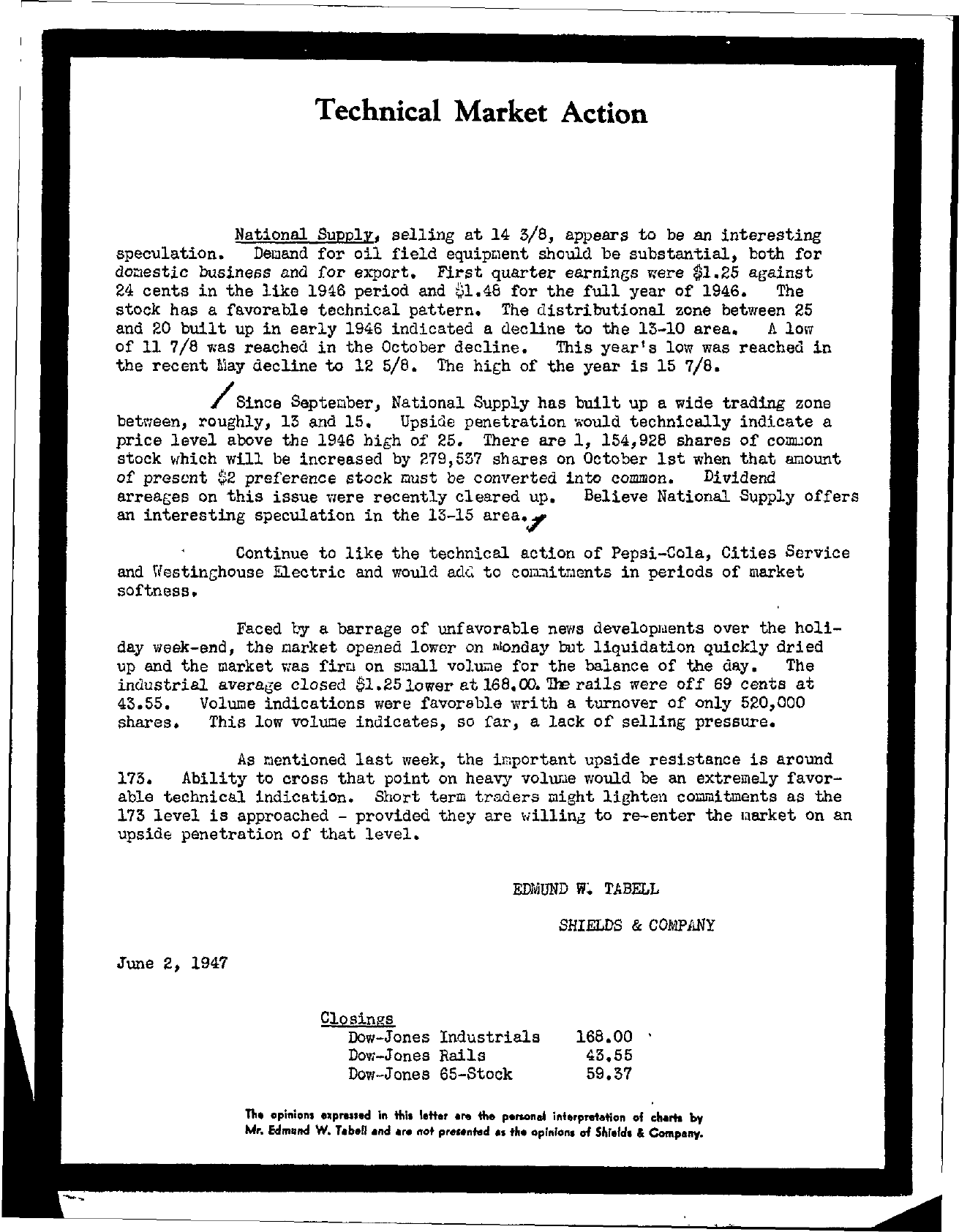
Technical Market Action National Supply, selling at 14 5/8, appears to be an interesting speculation. DeQand for oil field equiptlent should be substantial, both for dooestic business and for export. First quarter earnings were 1.25 against 24 cents in the like 1946 period and 1.48 for the full year of 1946. The stock has a favorable technical pattern. The distributional zone between 25 and 20 built up in early 1946 indicated a decline to the 15-10 area. A low of 11 7/8 Vias reached in the October decline. This year 1 s low was reached in the recent 1l1ay decline to 12 5/8. The hibh of the year is 15 7/8. Since Septeober, National Supply has built up a wide trading zone between, roughly, 15 and 15. Upside penetration Vlould technically indicate a price level above the 1946 high of 25. There are 1, 154,928 shares of comuon stock Ilhich wlll be increased by 279,557 shares on October 1st when that ru;ount of prescnt 2 preference stock ust be converted into common. Dividend arreages on this issue Vlere recently cleared up. Believe National Supply offers an interesting speculation in the 15-15 area. Continue to like the technical action of Pepsi-Cola, Cities Service and WestinGhouse EJ.ectric and would adG to cOld.ditr.1(mts in periods of market softness. Faced by a barrage of unfavorable news developluents over the holiday week-end, the 1arket opened lowcr on 1donday but liquidation quickly dried up and the market Vias firw on soall vollhde for the balance of the day. The industrial avera.;e closed 1.25 lower at 168.00. TIe rails were off 69 cents at 45.55. Volume indications were favorable writh a turnover of only 520,000 shares. This low voluoe indicates, so far, a lack of selling pressure. As tlentioned last Iveek, the important upside resistance is around 175. Ability to cross that point on heavy volurJe would be an extremely favorable technical indication. Short term traders might lighten CO;lllitments as the 175 level is approached – provided they are ;;illin,. to re-enter the laarket on an upside penetration of that level. J\Ule 2, 1947 EDMUND W TABELL SHIELDS & COMPANY Closings Dow-Jones Industrials Dow-Jones Rails DoV/-Jones 65-Stock 168.00 45.55 59.57 Th. opinions eapres.ed in this letter . the penonaA int.rpretation of ch.rta by Mr. Edmund W. r.b.n .nd .,.. not presented tIr. opinion. of Shr.ld. & Company.

Download PDF

Tabell’s Market Letter – June 04, 1947

Tabell’s Market Letter – June 04, 1947

Tabell's Market Letter - June 04, 1947
View Text Version (OCR)

Technical Market Action At its closing price of 18 1/4, Eastern Air Lines, from a technical viewpoint, appears to be an interesting speculation. The distributional pattern built up in early 1946 at around 55, indicated a reaction to the 19-17 level. The low reached in the October decline was 16 1/8. After further backing and filling, the stock reached a high of 2,4 1/4 in early April. A small top area was built up during that perio in the 24-25 level indicating a dip to 18. The May 10Vl was 17 1/4. The subsequent rally carried Eastern Air Lines back to above 20. The news of the plane crash last week-end brought the stock back to 18 1/4. This price was reached again on Wednes6ay's close. It will be noted that, so far, the stock has met support at successively higher levels. This fact, coupled with the substantial base pattern around the 18 level, would indicate that speculative purchases of this financially strongest airline appear warranted. Pepsi-Cola, at Wednesday's low of 28 1/2 and closing at 28 5/4, appears to have hau a sufficient correction of the 5 5/8 advance from 25 1/4 to 50 5/8. Purchase is adVised in the 28-29 area. Would also add to commitments in Cities Service, National Supply and Westinghouse Electric in periods of market weekness. After reaching a high of 171.55 on Wednesday, the market reacted in the final hour ano closed 79 cents lower on the day at 169.56. Volume for the day was 820,000 shares with a turnover of 270,000 shares in the final hour sell-off. The final hour sell-off volume just about coincides with the 260,000 share turnover in the final hour rally of Tuesday. The 175 level continues to be the important upside resistance pOint. Further backing and filling and irregularity could take place before a decisive penetration of this very important technical level occurs. As mentioned earlier in the week, short term traders might lighten commitments as the 175 level is approached, as on Wednesday, provided they are willing to re-enter the market on an upside penetration of that level. June 4, 1947 EDMUND Ii. TABELL SHIELDS & COMPANY CloSings Dow-Jones Industrials Dow-Jones Rails Dow-Jones 65-Stock 169.56 45.57 59.71 The ophtlens p,tllHd in this I.-H., fllre the penon. int.rpretation of cham by ,. Edmund W. f.b.U end .,. not pres.nted ., th. opintOM of Shl.1d. .. Compe,. -1

Download PDF

Tabell’s Market Letter – June 09, 1947

Tabell’s Market Letter – June 09, 1947

Tabell's Market Letter - June 09, 1947
View Text Version (OCR)

Technical Market Action In a letter dated April 24th, we drew attention to the better-than- market action of the oil stocks and advised their purchase during periods of market weakness. We particularly mentioned Gul! Oil at 60 and Standard Oil of New Jersev at 66 5/8 in the higher priced group, Ohio Oil a 25 and Pure Oil at 25 7/8 in the lower priced field and in the more speculative group, Houston Oil at 20 1/2 and Texafl Pacific Coal & Oi.l at 29. In the subsequent May decline, these icsues continued their better-than-market action and held above previous lows. In the past two Ieeks, the oils have beE among the market leaders and Gulf Oil and Standard of New Jersey reached new high territory for 1947. Monday's closing prices were – Gulf Oil 64t, Standard of New Jersey 75 1/4, Ohio Oil 22 7/8, Pure On 25 7/8, Houston Oil 21 5/4, and Texas Pacific Coal & Oil 29 1/2. Believe these issues indicate higher levels and advise their jJurt!hase in periods of market vleakness;l' Cities Service, another recent recommendation, also belongs in the oil group. After disposal of public utility properties, it will be an oil and natural gas company. At HE present price of 50 3/4, it appMrs very conservatively valued. Its purchc.se is advised on soft spots together with National Supply, wMch,as an oil field equi)ment issue, should also participate in favorable outlook for the petroleum group. Another issue with a favorable technical pattern is Shamrock Oil & Gas. This cor.tpany, ovmer of extensive oil and gas properties, has increased the dividend rate to 30 cents quarterly. A substantial base pattern has been built up in the 21-25 area 3nd an upside penetration would indicate hieher levels. The market continues dull and irregular. The important upside resistance is around the 175 level. Pending penetrat.ion of that important level, would expect irregularity and a possible testing of recent loVl levels. Advise trading purchases on sell-offs or on penetration of the 173 Jevel. June 9, 1947 EDMUND Ii. TABELL SHIELDS & COMPANY Closings Dow-Jones Industrials DoV/-Jones Rlils Dow-Jones 65-Stock 169.88 45.25 59.68 TIt. opln;on, apreued in this letter er. tM persone.i interpretation of cham by T.b.nMr. edMund W. end .r. not presented ., tl,. opinions of Shl.ld… Compcay.

Download PDF

Tabell’s Market Letter – June 11, 1947

Tabell’s Market Letter – June 11, 1947

Tabell's Market Letter - June 11, 1947
View Text Version (OCR)

Technical Market Action The industrial average penetrated the 175 level and technically indicates an important change in the trend. The technical patterns of a number of investment trust issues seem to bear out our oft-repeated assertion since September 1946 that the 170-160 level was a long term buying range. For example, AdamS Express, a large trust with diversified holdinbs, indicated a decline to 15 from its distributional area built up around 24-22 in early 1946. The October low was 15 1/8 and this exact point was again reached last month. Wednesday's closing was 14 7/8. A substantial base pattern has been built up in the 14-18 area. An upside penetration would give a rally indication above the 1946 hih of 24 5/4. A similar pattern is to be in U. S. & Foreign Securities. Its 1946 distributional area indicated a downside objective of 16. The October low was 15 1/2 and 15 5/8 was reached last month. Again a substantial base pattern has been built up in the 16-21 range with an eventual rally indication above the 1946 high of 32 1/2 if an upside penetration occurs. Wednesday's close was 18 1/2. Still a third example is Atlas Corporation, a special Situation investment trust. The downside objective of 23-21 was reached in October at 22 1/2 and in May at 21 5/8. The base built up between 23 and 25 suggests a higher price level than 1946 high of 54 5/6 if an upside penetration occurs. Last sale was 25 1/2. All three of these issues are .suggested for purchase by those who prefer to buy a cross section of the market rather than select individual issues. In the case of Atlas Corporation, the warrants listed on the Cur could show greater percentage appreciation. The 1946-1947 range is 15 high and 5 5/8 low. '/ednesday's close was 5 1/4. Several recently recommended issues reached new high ground for 1947 in \iednesday's strong market. Included in this group were Standard Oil of New Jersey, Gulf Oil, Cities SerVice and National Supply. Others such as Westinghouse Electric and Pepsi-Cola were very near to the 1947 highs. While market leaders spearheaded the upmove on Wednesday, it would be logical to expect some of the secondary issues to come into the picture shortly. Two such issues are Evans Products and Houdaille Hersbey. Evans Products has been meeting support at progressively higher levels since October. The 1946 low of 15 1/4 just about reached the downside objective of 15 outlined by the distribution area around the 55-50 level early in 1946. The 1947 low was 18 and Wednesday's closing 21 5/8. A. sufficient base area has been built up to indicate substantially higher levels. This loading equipment issue showed earnings of 4i2.58 in the first Ciuarter. Houdaille Hershey in the auto accessory field also has a good technical pattern. Vlhile the October low of 12 1/2 did not quite reach the indicated down- side objective of 11, the large base formed in 14-18 area and the fact that the May lOVI, at 15 1/4, held above the previous low, makes he issue worthy of consideration. An upside penetration would indicate levelS considerably above the 1946 high of 28 5/8. Wednesday's rally to 174.68 in the industrials, up 5.58 on the day, broke the downtrend lines from both the May 1946 high and February 1947 high. It also penetrated the important 200-day moving average on the upside. The rail average also joined in the advance to close 1.29 higher at 44.71. Such action indicates, in my opinion, a breaking of the downtrend and the start of an important upswing from the huge 170-160 accumulation area. Obviously, the advance will be punctuated by reactions but such occasions should be used to add to hold- ings. l!DMUND l'i. TABELL June 11, 1947 SHIELDS & COMPANY Closing Dow-Jones Industrials 174.68 Dow-Jones Rails 44.71 Tho opinion. dlfIeS.is6litt.'lI!.. ponon.1 inter of chorb by Mr. Edmund W. rabell and .re not presented al the opinions of Shield, I. Company

Download PDF